

Foodservice Trends Book 2026: Coming Full Circle
Ten years ago, we published the first edition of what has become our annual Foodservice Trends Book.
It was printed, more conceptual than data-led, and very much of its time. Looking back now, what is most striking is not that every idea landed exactly as expected. They didn’t. The interesting part is how many early signals went on to shape the market in real ways: robot waiters, app ordering, zero waste, food halls, hyper-personalisation, immersive dining, social eating, craft drinks, delivery formats, regional cuisines and the growing expectation that foodservice should stand for something. That is why this year’s edition is called Coming Full Circle.
Not because foodservice is returning to 2015, but because the same questions are back in sharper form. What makes people leave the house? What makes an offer feel worth the money? How do we balance efficiency with hospitality? When does innovation create value, and when is it just noise? How do we build foodservice that is commercially viable, socially useful and genuinely enjoyable?
Entering 2026, the market is still full of tension. Demand has not disappeared, but profitability remains fragile. Between June 2019 and June 2025, UK consumer spending on foodservice rose by 10%, reaching record highs, while total visits remained 10% below pre-pandemic levels. In the UK, 59% of diners are opting for cheaper restaurants. In the UAE, 54% of residents have changed their dining preferences to save money, with 55% seeking discounts or coupons and 49% choosing cheaper restaurants. In Germany, 40% of hospitality businesses fear losses once 2025 accounts are finalised.
That tells us a lot. People still want to eat out, but they are more selective, more value-conscious and quicker to question what they are getting in return.
For landlords, developers and operators, this is an important moment. F&B is still a footfall driver. It is still what can make a workplace, airport, hotel, mall, cultural venue or city centre feel distinctive. But the economics are tighter, and the old habit of expecting operators to absorb every cost pressure without support is not sustainable. Good foodservice mixes need strong brands, but they also need local operators, community-led businesses and offers that create genuine reasons to visit.
The 2026 book looks at this through a long lens: then, now and next. Some trends have matured. Some have changed shape. Some have contradicted each other entirely. That is not a problem. Foodservice is too broad, too local and too human to move in one neat direction.
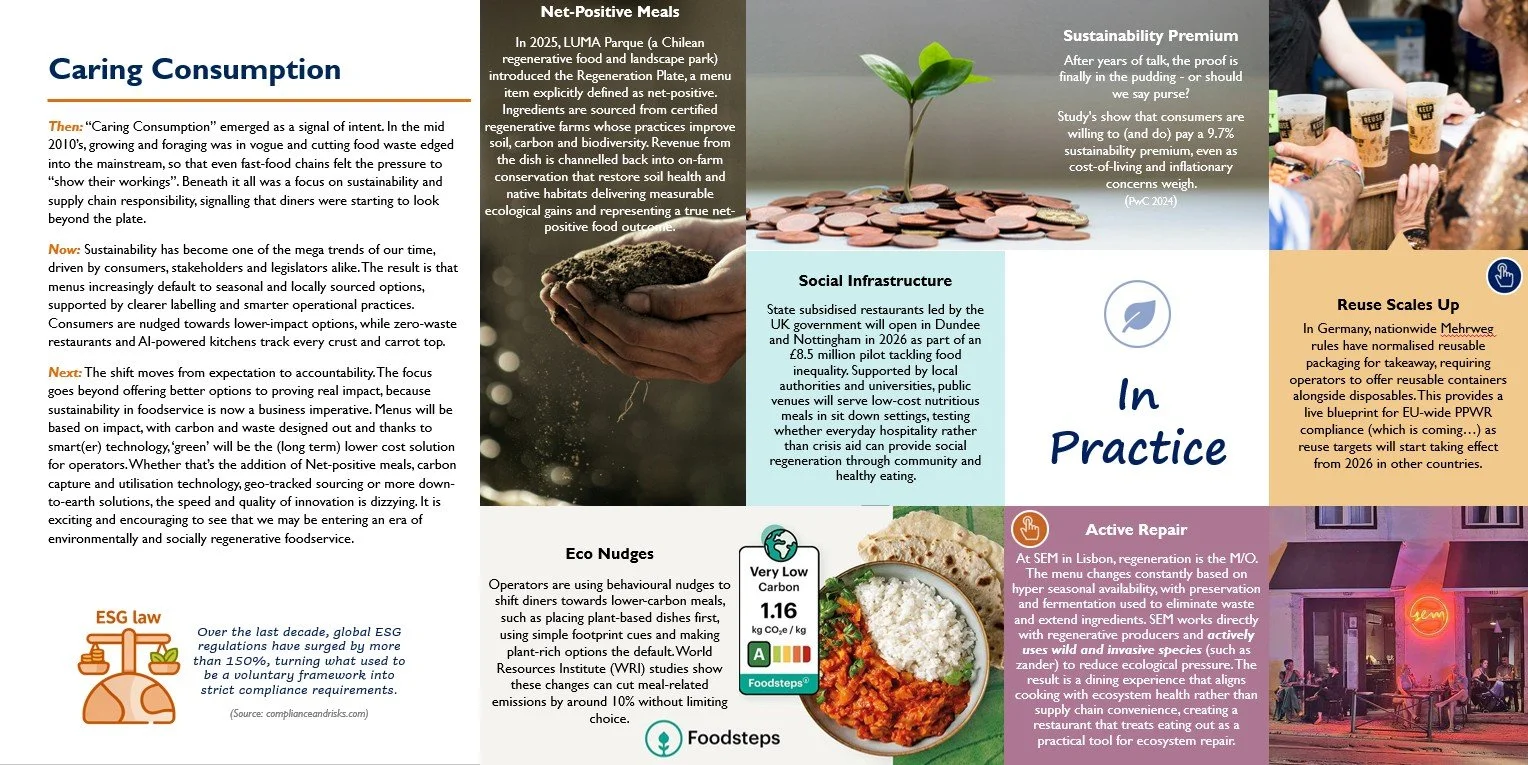
Take sustainability. Ten years ago, “caring consumption” was mainly about intent: growing, foraging, reducing waste and showing diners that businesses were thinking beyond the plate. Now it is a business imperative, pushed by customers, legislators, investors and operating costs. The next stage is accountability. Net-positive meals, geo-tracked sourcing, reusable systems, eco-nudges and regenerative supply chains are moving sustainability from good messaging into measurable impact.
Make it stand out
There are some brilliant examples. At SEM in Lisbon, the menu changes around hyper-seasonal availability, preservation and fermentation, with wild and invasive species such as zander used to reduce ecological pressure. In Chile, LUMA Parque’s Regeneration Plate is explicitly defined as net-positive, using ingredients from certified regenerative farms and channelling revenue back into conservation. In Germany, nationwide Mehrweg rules are normalising reusable takeaway packaging. In the UK, state-subsidised restaurants are due to open in Dundee and Nottingham in 2026 as part of an £8.5 million pilot tackling food inequality through low-cost, sit-down meals.
Personalisation is also evolving. What began as swapping sides and choosing sauces has become a much wider conversation about health, appetite, identity and data. By 2025, 9% of consumers trying to lose weight were using GLP-1 drugs, reshaping appetite, portion tolerance and meal frequency. Heston Blumenthal’s Mindful Experience menu at The Fat Duck is a good example of a premium operator responding without stripping out pleasure: a smaller version of the classic multi-course experience, priced at £275 versus £350 for the full tasting menu.
Elsewhere, Sweetgreen is adding macro-tracking and protein-forward bowls, including a Power Max Protein Bowl with 106g of protein. Poke House reports that around 85% of orders are fully customised. Healthy-by-default models in Brazil are redesigning large-scale school, factory and workplace dining by removing ultra-processed foods at procurement level, rather than relying on individual willpower at the point of choice.
Choice, however, is not always the answer. Ichiran Ramen offers one perfected tonkotsu ramen through vending-machine ordering across more than 80 locations globally. It is almost an anti-trend: less choice, more certainty, less decision fatigue. And it works.
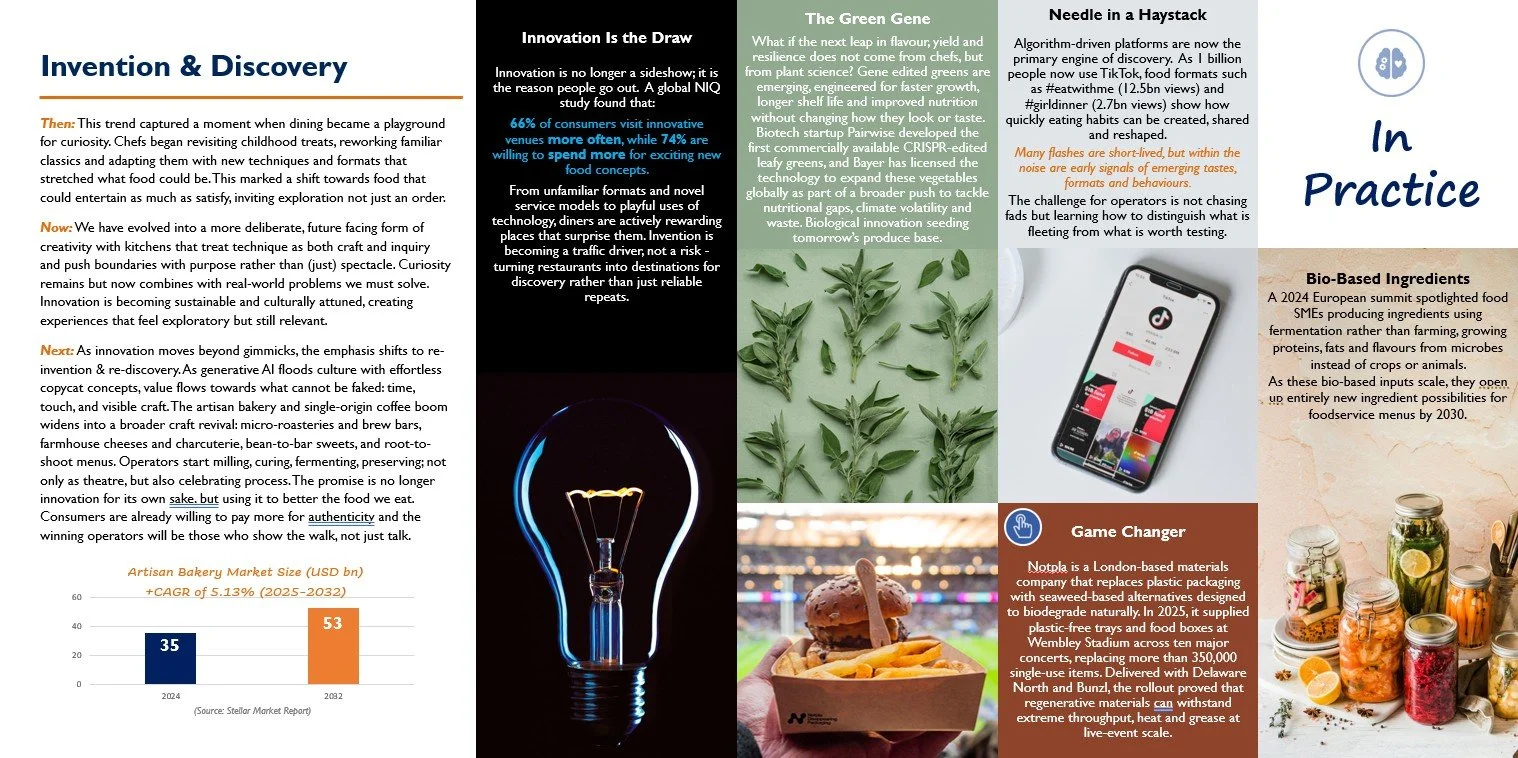
Technology is doing what it always does best when used properly: removing friction, improving consistency and giving people time back. Voice AI in foodtech is projected to exceed $2.5 billion by 2027, growing at around 32% annually. A UK Burger King drive-thru pilot uses AI not just to take orders, but to flag lower-impact “eco” choices. In Japan, pilots are testing dynamic pricing linked to expiry data, electronic shelf labels and POS systems, helping operators reduce waste and protect margin. In Atlanta’s Peachtree Corners, Pipedream Labs is testing underground tube delivery for food orders, starting with sandwiches and lunch runs.
The question is not whether technology belongs in foodservice. It already does. The better question is where it should sit. The best uses will often be behind the scenes: forecasting, labour planning, stock management, waste reduction, traceability and service choreography. Visible hospitality becomes more valuable when the duller operational load is reduced.
Experience is also becoming more serious. Not serious in tone, but serious in commercial importance. Restaurants have moved beyond “a nice meal with a nice interior”. The strongest experience-led concepts now behave more like cultural venues, theatres, games, fan worlds or social infrastructure.
Netflix House is opening permanent venues in Philadelphia and Dallas, with a third planned for Las Vegas in 2027. Each will include Netflix Bites, a casual restaurant with food and drinks inspired by Netflix stories and characters. Qiddiya City in Saudi Arabia is being designed around the “Power of Play”, with 400 attractions, 275 rides, 2,000 art installations and 43 sports facilities. Freight Island is taking a 60,000 sq ft indoor-outdoor venue to Newcastle, combining immersive entertainment, restaurant service, global street food and a food hall with a retractable roof.
At a smaller scale, scarcity and rotation are becoming more organised. Eventbrite’s 2025 findings show 82% year-on-year growth in pop-up dining events, with 75% of attendees willing to pay more for one-off dining experiences. Carousel in London has turned guest-chef residencies and short-run collaborations into a permanent business model. Silo is closing its East London site after 11 years as the world’s first zero-waste restaurant, not as a retreat, but to take its closed-loop systems on the road through pop-ups and collaborations.
This is not novelty for novelty’s sake. It is a response to a weary consumer who still wants reasons to gather, celebrate and feel something.
At the same time, foodservice is becoming more careful about trust. The old anti-brand mood has professionalised. Diners still like independent, unpolished and local, but they also want proof. OpenSC, developed with WWF and BCG Digital Ventures, uses blockchain technology to track individual products through the supply chain, making origin and handling data visible at point of use. Nobelhart & Schmutzig in Berlin is “vocally local”, sourcing within 250km and being transparent about its producer relationships. Dishoom has grown slowly, with each site designed around its neighbourhood rather than a fixed template. Big Mamma Group has more than 30 restaurants across Europe, but each has its own name, story and personality, hiding scale behind local feeling.
Inclusive foodservice is another area where the next phase feels less optional. By 2050, almost 30% of the EU27 population will be aged 65 or over. Seoul Asan Medical Center’s GrEATing soft protein hamburger steak, designed for older adults with chewing and swallowing difficulties, delivers 19g of protein while maintaining familiar flavours and textures. Roots in Modena operates as both a restaurant and paid training programme for migrant and refugee women, supporting 43 women from 19 countries into hospitality careers in just two years. Dialogue Express Café continues to show how ordering in British Sign Language can create genuine connection between deaf and hearing communities.
Foodservice has always been about more than food. The difference now is that the “more than food” bit has to be designed, costed, staffed, measured and delivered properly.
That is perhaps the biggest lesson from looking back over ten years. Trends do not arrive fully formed. They build slowly, collide with economics, get reshaped by culture, and only become useful when they meet a real need. The industry does not need to chase every idea. It needs to know which ones deserve attention, which ones need time, and which ones are better left as noise.
The 10th edition of the Coverpoint Foodservice Trends Book is available to download now.
Happy reading, and as always, let us know which pioneering innovations you would add to the list.